
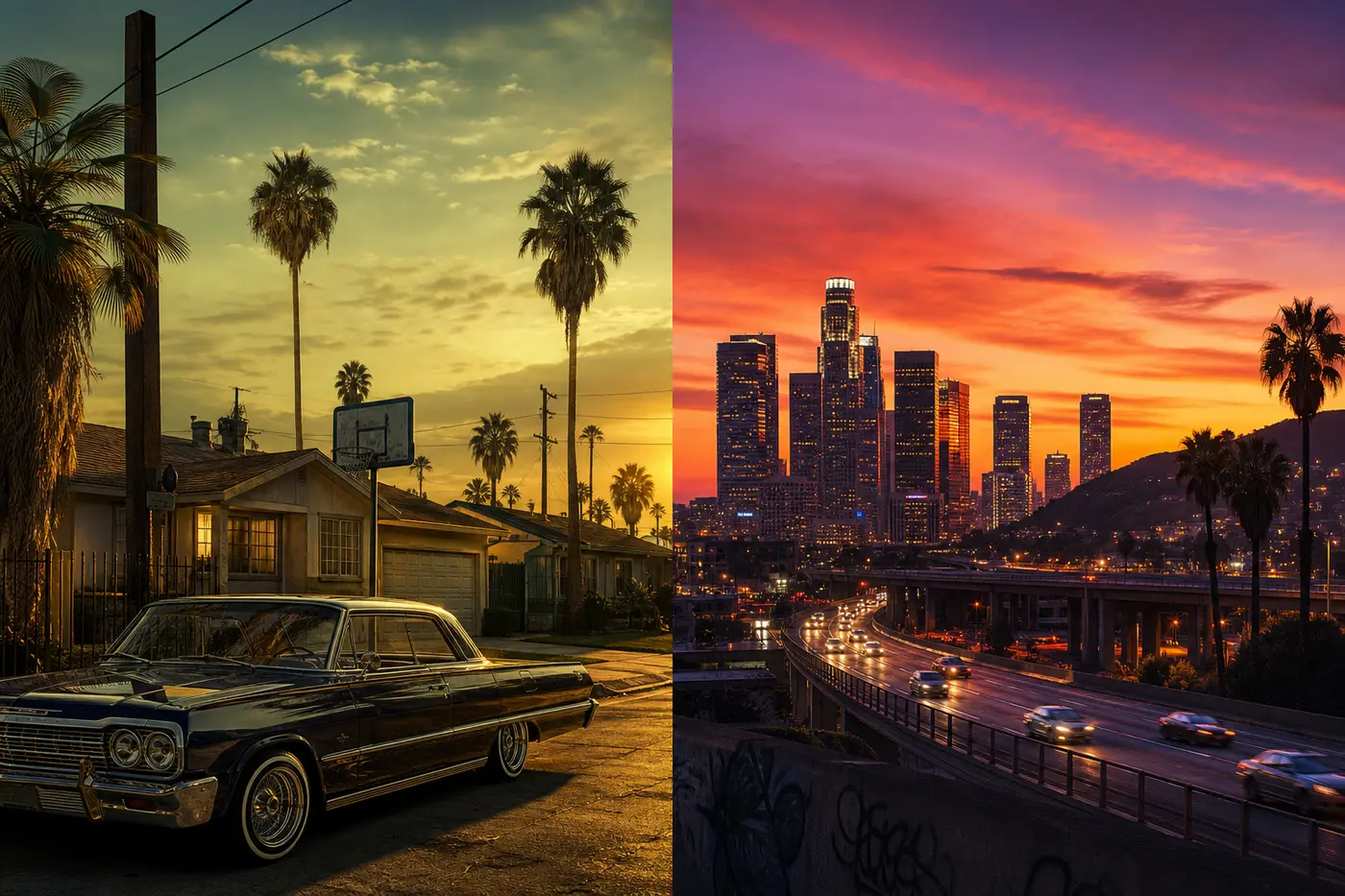
Twenty years after it hit PlayStation 2, GTA San Andreas is still the peak of the saga for a lot of players, and yet it’s GTA 5 that blew the doors off at retail. The two games share a name for the territory, the state of San Andreas, and one central city, Los Santos. But between the 2004 version and the 2013 version, Rockstar rebuilt everything: engine, scale, tone, gameplay. Here’s what really separates these two landmarks.
The same San Andreas state, two worlds
The trap is to assume GTA 5 takes place “after” San Andreas. In reality, the two titles belong to separate universes. San Andreas (2004) is part of the series’ 3D era, kicked off by GTA III, and covers the entire fictional state of San Andreas, inspired by California and Nevada, in 1992. GTA 5 (2013) belongs to the HD era launched by GTA IV: it reuses the state’s name but keeps only one of its cities, Los Santos, Rockstar’s take on Los Angeles, completely redrawn and surrounded by rural Blaine County. Carl “CJ” Johnson, the 2004 hero, simply doesn’t exist in the world of GTA 5.
RenderWare vs RAGE: a nine-year technical leap
San Andreas ran on RenderWare, the third-party engine that powered the franchise’s entire PS2 era. It was a feat for Sony’s console, but with the limits of the time: heavy pop-in, blocky models, crude physics. GTA 5 sits on the in-house RAGE engine, backed by the Euphoria physics inherited from GTA IV, capable of believable ragdolls, dynamic weather, a fine-grained day-night cycle, and dense traffic. It’s that technical foundation, re-released across three console generations, that explains why GTA 5 still holds up since 2013.
Three cities in 2004, one oversized Los Santos in 2013
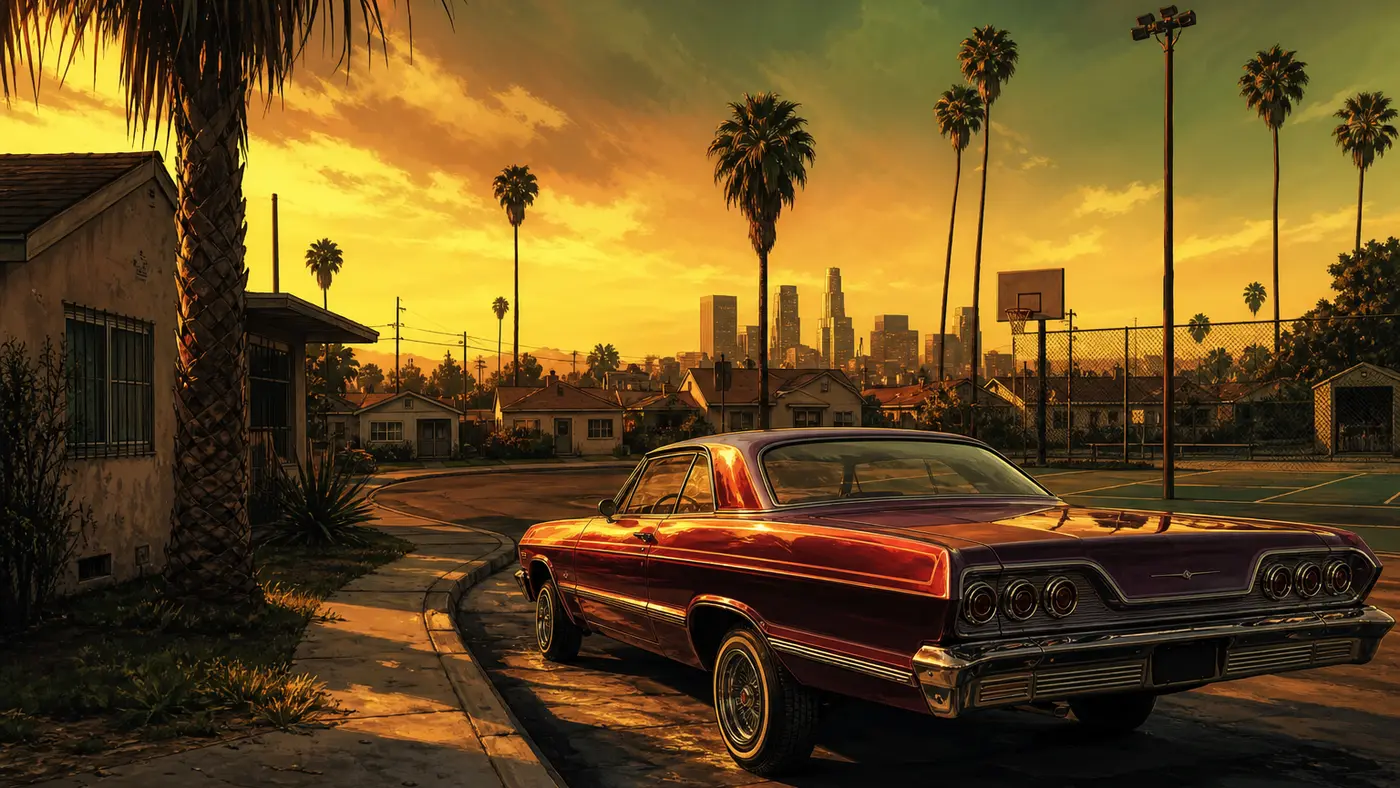
This is the great paradox of the comparison. On paper, GTA 5 is clearly bigger, around 76 km² (about 29 sq mi) versus roughly 33 km² (about 13 sq mi) for San Andreas by community estimates. But San Andreas spread its area across three full cities, Los Santos (Los Angeles), San Fierro (San Francisco), and Las Venturas (Las Vegas), connected by countryside, mountains, and a desert. GTA 5 concentrates everything on a single Los Santos that’s infinitely more detailed and vertical. The result: a lot of players remember San Andreas as the “bigger” game, when it’s actually smaller but more varied. To place each entry on the timeline, see our rundown of every GTA game in order.
CJ, Grove Street, and the Families: a reinvented legacy
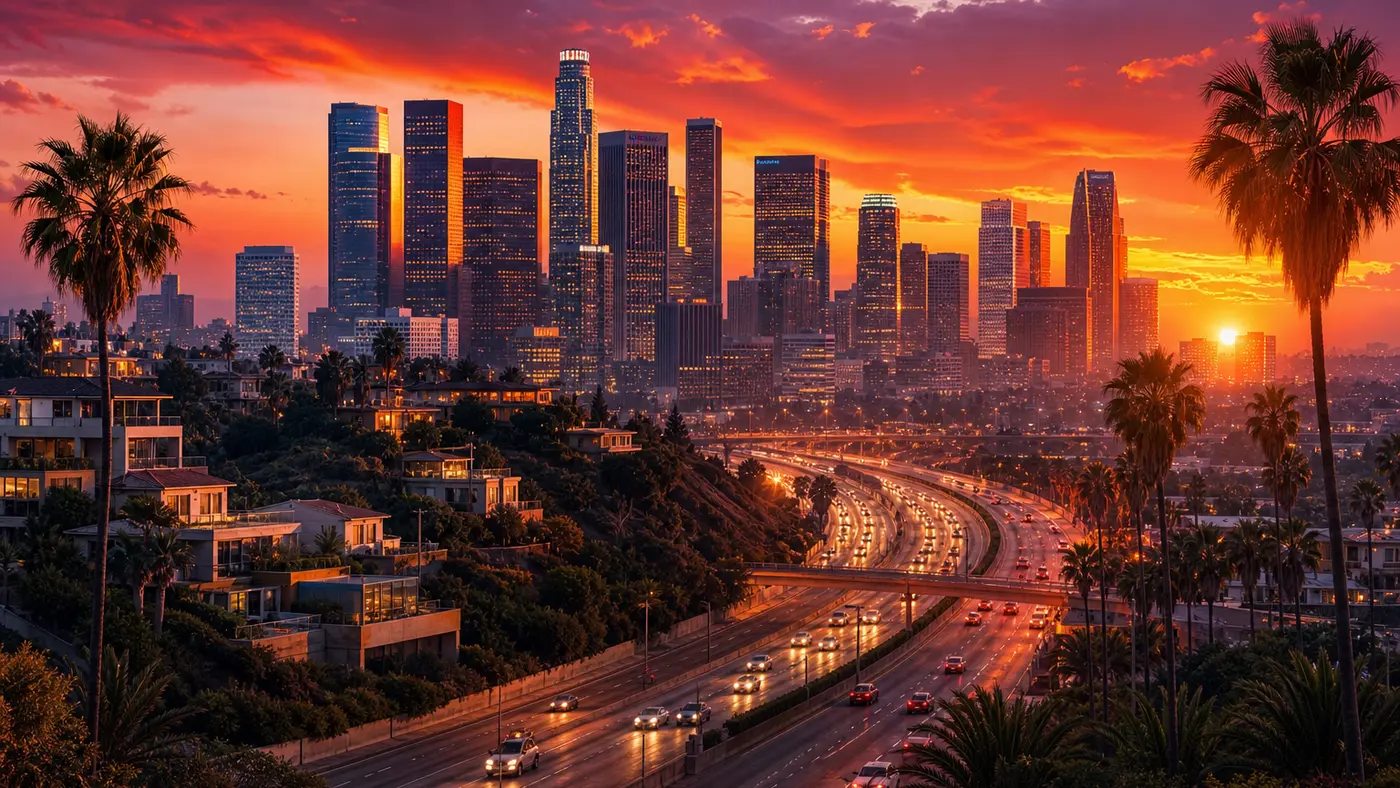
Rockstar didn’t forget San Andreas while building GTA 5. Grove Street is right there, CJ’s old neighborhood, along with the Families gang that Franklin Clinton comes from. But be careful: these are reinterpretations, not sequels. CJ’s original crew, in GTA 5’s fiction, fell apart after the ’90s, its members “dead or moved on,” as Lamar reminds Franklin. The modern Families are modeled on the San Andreas sets without being their direct continuation. An elegant way for the studio to salute 2004 while starting from a blank narrative page.
San Andreas’s RPG mechanics, ahead of their time
If San Andreas left such a mark, it’s also because it introduced ideas the series has never fully abandoned. CJ could put on muscle or fat depending on what he ate and how often he hit the gym, change his haircut, his clothes, get tattoos, and earn respect with the gangs. It was the first game where you could fly planes, you took over territories, you customized your lowriders with hydraulics. GTA 5 streamlined all of that (clothing, tuning, fitness through the protagonists), but the idea of a hero you shape comes straight from 2004. It’s that bedrock of detail that still fuels the hunt for secrets, like in our roundup of GTA 5 easter eggs.
Hot Coffee: the scandal that changed the industry
You can’t talk about San Andreas without bringing up Hot Coffee. In 2005, modders dug up a sexual minigame left disabled in the code. The controversy snowballed, the ESRB re-rated the game “Adults Only,” US retailers pulled it from shelves, and Take-Two faced investigations and class-action lawsuits. The affair permanently toughened ratings policy and scrutiny of hidden content. It’s a reminder that San Andreas, behind the nostalgia, was also one of the most controversial games of its time.
Sales: two records at very different scales
The numbers sum up the gap in resources between two eras. San Andreas moved 27.5 million copies and remains the PlayStation 2’s best-seller, a colossal performance for 2004. GTA 5, meanwhile, has crossed 225 million units (Take-Two figure from February 2026), making it the second best-selling game of all time, behind Minecraft. The difference isn’t just about quality: in the meantime, the market exploded, the game shipped on three generations of hardware, and GTA Online turned GTA 5 into a long-running service where San Andreas had no online mode at launch.
And where does GTA 6 fit in?
The circle is about to close. GTA 6 leaves California for Florida and Vice City, but it inherits everything San Andreas and GTA 5 built: a dense open world, a hero you embody, biting satire. To measure how far things have come, check out our GTA 5 vs GTA 6 feature and our tour of the Leonida map. From Los Santos 1992 to Vice City 2026, it’s the same obsession with detail running through thirty years of Rockstar.
Comments
Be the first to react.